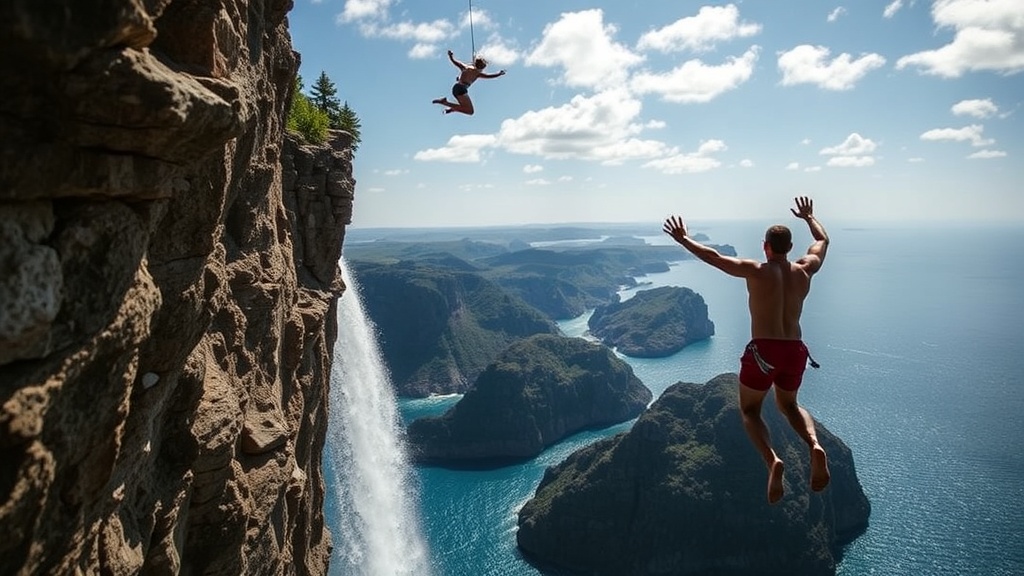
The Complete Cliff Diving Training Guide: From First Jump to Pro

What Does This Cliff Diving Training Guide Cover?
This guide walks through the progression from pool training to 85-foot cliff drops — covering physical conditioning, mental preparation, entry techniques, and safety protocols that separate competent divers from world-class competitors. Whether standing on a 10-meter platform for the first time or eyeing the cliffs of Acapulco, the information here will help build skills systematically without injury setbacks. Cliff diving isn't just about courage. It's about preparation, technique, and respect for physics that don't forgive mistakes.
What Physical Training Do Cliff Divers Need?
Cliff divers need explosive lower-body power, core stability that rivals gymnasts, and shoulders capable of withstanding 2.5G impacts — not marathon endurance or bulky muscle mass.
The training split differs from traditional diving. Pool divers hit the water at roughly 35 mph from a 10-meter platform. Cliff divers at 27 meters (the standard Red Bull competition height) hit 55 mph. The force multiplication isn't linear — it's exponential. Your body must be bulletproof in specific planes of motion.
Strength priorities:
- Plyometric legs: Box jumps, depth jumps, and single-leg bounds build the explosive power for takeoffs. The Red Bull Cliff Diving World Series athletes train plyometrics three times weekly — but never on consecutive days.
- Rotational core: Russian twists with medicine balls, cable woodchoppers, and hanging windshield wipers develop the torque control needed for twists and somersaults. A weak core equals a floppy entry — and bruised ribs.
- Shoulder durability: External rotations with bands, Turkish get-ups with kettlebells, and handstand holds against walls prepare shoulders for the violent deceleration of water impact.
Cardio matters — but differently than most athletes expect. High-intensity interval training (HIIT) on rowing machines or assault bikes mimics the short, intense bursts of cliff diving. Long-distance running? Not particularly relevant. The metabolic demands of a competition dive last roughly three seconds.
Here's the thing: flexibility isn't optional. Divers need overhead mobility for handstand takeoffs and hip mobility for pike positions. Yoga sessions twice weekly — specifically vinyasa flows emphasizing shoulder openers and hip flexor stretches — prevent the compensations that lead to injury.
How Do Beginners Progress Safely From Pool to Cliff?
Beginners should log 200+ hours on 10-meter platforms, master four core dives (forward, back, reverse, inward), and achieve consistent "rip" entries before considering natural cliff environments.
The progression isn't glamorous. It's repetitive. Most aspiring cliff divers spend 18-24 months in controlled aquatic facilities before touching natural rock. That said, the foundation determines everything that follows.
Stage One: Platform Mastery (Months 1-6)
Start at 5 meters. Learn the lineup — body tension, head position, arm placement. The entry matters more than the dive complexity. A perfect layout from 5 meters beats a sloppy 1.5 somersault. Coaches at USA Diving facilities emphasize "entry quality over difficulty" for the first 500 dives.
Progress to 7.5 meters only when entries consistently produce minimal splash. The sound of a proper entry? A sharp "thwack" — not a splash. The water doesn't lie.
Stage Two: Height Acclimation (Months 7-12)
The 10-meter platform changes everything. Visualization becomes as important as physical practice. Many divers use visualization techniques from the Association for Applied Sport Psychology — mentally rehearsing every micro-movement before stepping onto the board.
At this stage, divers learn "spotting" — picking visual references during rotations. The horizon, the water, specific landmarks. Without spotting, divers lose orientation. Disorientation at height equals poor entries at best, injury at worst.
Stage Three: Environmental Transition (Months 13-24)
The catch? Natural cliffs aren't concrete and stainless steel. They're uneven, wind-affected, and often require hiking with gear. Popular training locations include:
- Possum Kingdom Lake, Texas: Reliable cliffs from 15-60 feet, clear water, minimal boat traffic.
- Wailua Falls, Kauai: Advanced only — 80-foot drops into variable depths. Requires local knowledge.
- Rick's Café, Negril, Jamaica: Tourist-friendly 35-foot platform with professional supervision — ideal for first natural cliff experiences.
Never train alone. The Red Bull Cliff Diving medical team recommends dive partners with throw ropes, first aid certification, and established emergency protocols for every session.
What Equipment Do Cliff Divers Actually Need?
Beyond a competition suit (or board shorts for men), cliff divers need impact-resistant wetsuits for cold water, specialized ear protection, and footwear for hazardous approaches — not much gear, but what exists must perform under extreme conditions.
| Equipment | Purpose | Recommended Options | Price Range |
|---|---|---|---|
| Competition Suit | Hydrodynamics, modesty, sponsor visibility | Speedo Endurance+, Arena Powerskin | $80-$400 |
| Impact Vest | Rib protection during learning phase | Jobe Progress Impact Vest, O'Neill Superfreak | $60-$120 |
| Wetsuit (Cold Water) | Thermal protection, buoyancy | Patagonia R2, Xcel Infiniti 3/2mm | $200-$400 |
| Ear Protection | Prevents rupture from pressure changes | Docs Proplugs (vented), JBL Hydro Seal | $15-$25 |
| Approach Shoes | Traction on wet rock | Five Ten Freerider, Astral Brewer | $100-$140 |
| Throw Rope | Emergency rescue capability | Sterling Rope Waterline, NRS Throw Bag | $40-$80 |
Worth noting: most professional cliff divers don't use wetsuits during competition. The Red Bull series uses platforms above warm water — Dubrovnik, Polignano a Mare, Bilbao. But training often happens in less forgiving environments. The Columbia River Gorge (a popular training spot for Pacific Northwest divers) demands 5mm wetsuits even in summer.
Technology Integration
Modern training uses video analysis extensively. Apps like Dartfish Express allow frame-by-frame breakdown of takeoff angles, rotation speed, and entry alignment. Many divers mount GoPro Hero 12 cameras at water level — the 240fps slow-motion reveals flaws invisible to the naked eye.
Fitness tracking matters too. Whoop 4.0 bands monitor recovery metrics, helping divers avoid overtraining. The impact forces of cliff diving create micro-traumas that accumulate. Ignoring recovery data leads to stress fractures — particularly in the feet and lumbar spine.
What Mental Skills Separate Good Divers From Great Ones?
Great cliff divers possess pre-shot routines that eliminate decision fatigue, fear-management techniques refined through exposure therapy, and the ability to maintain "flow state" during 2.5-second descents — mental skills often more decisive than physical ones.
Fear isn't the enemy. Complacency is. Standing on a 27-meter platform (roughly nine stories), the body produces cortisol and adrenaline automatically. The diver who panics tenses. Tension equals poor form. Poor form equals pain.
Breathing techniques from freediving help enormously. The mammalian dive reflex — slowed heart rate, peripheral vasoconstriction — can be triggered with specific breath-hold patterns. Many cliff divers train with AIDA International instructors to master CO2 tolerance tables and diaphragmatic breathing.
The pre-dive routine becomes automatic. A specific number of breaths. A visualization sequence. The arm raise signal. When every dive follows an identical mental checklist, there's no room for "what if" thoughts. The body executes what the mind has rehearsed a thousand times.
"At height, you don't rise to the occasion. You fall to your level of training." — Traditional diving aphorism
Competition Psychology
Red Bull Cliff Diving competitions feature four dives from 27 meters — two required dives, two optional. The pressure compounds. Divers wait 30-45 minutes between attempts. Staying mentally sharp through that interval separates medalists from also-rans.
Many competitors use "process goals" rather than outcome goals. Instead of "score 9.0s," the goal becomes "hold the pike position until 180 degrees of rotation." Controllable, specific, technical. The score follows the execution.
How Dangerous Is Cliff Diving Really?
Competition cliff diving under professional supervision carries injury rates comparable to NCAA gymnastics — roughly 2-3 significant injuries per 1,000 exposures — while unsupervised recreational cliff diving has significantly higher rates of spinal compression fractures, concussion, and drowning.
The physics are unforgiving. Water surface tension at impact speeds behaves like concrete. Professional divers "break" this tension by entering fingertips-first (or toes-first for feet-first entries) with a simplified body. Even slight deviations — a bent elbow, a tilted head — distribute force unevenly.
Common injuries include:
- Compression fractures: The spine absorbs 2-3 times body weight on poor entries. Most common in learning phases.
- Os trigonum syndrome: An extra bone behind the ankle (present in 10% of the population) gets crushed during pointed-toe entries. Requires surgical removal for competitive divers.
- Perforated eardrums: Pressure changes during entry without proper ear protection.
- Concussions: Usually from hitting the water with poor head position — the brain rattles inside the skull.
Depth matters enormously. The Red Bull platform in Mostar, Bosnia requires 7 meters of water depth minimum. Natural cliffs often have unknown depths, submerged rocks, or debris. Never dive into water you haven't verified — preferably by having a partner swim the landing zone with dive fins and a mask.
Safety Protocols That Save Lives
Professional operations follow strict protocols. Divers enter the water feet-first after each dive to check conditions before head-first attempts. Spotters monitor wind speed — anything above 15 mph can push divers off target. Safety divers in the water wear scuba gear to assist if a diver fails to surface immediately.
Recreational divers should adopt these standards. The "send it" mentality — jumping without preparation — fills emergency rooms. Proper training, verified depths, weather awareness, and never diving alone. These aren't suggestions. They're survival requirements.
The path from first jump to professional cliff diver spans years, not months. Patience with the process — building physical capacity, technical precision, and mental control in that order — creates sustainable careers. Athletes like Gary Hunt (seven-time Red Bull world champion) and Rhiannan Iffland (dominant women's competitor) emphasize consistency over intensity. They train smart, recover completely, and respect the height.
Your first 10-meter platform dive will feel terrifying. Your hundredth will feel routine. The cliffs will always demand respect — but with proper preparation, they'll also deliver the most exhilarating three seconds in sports.