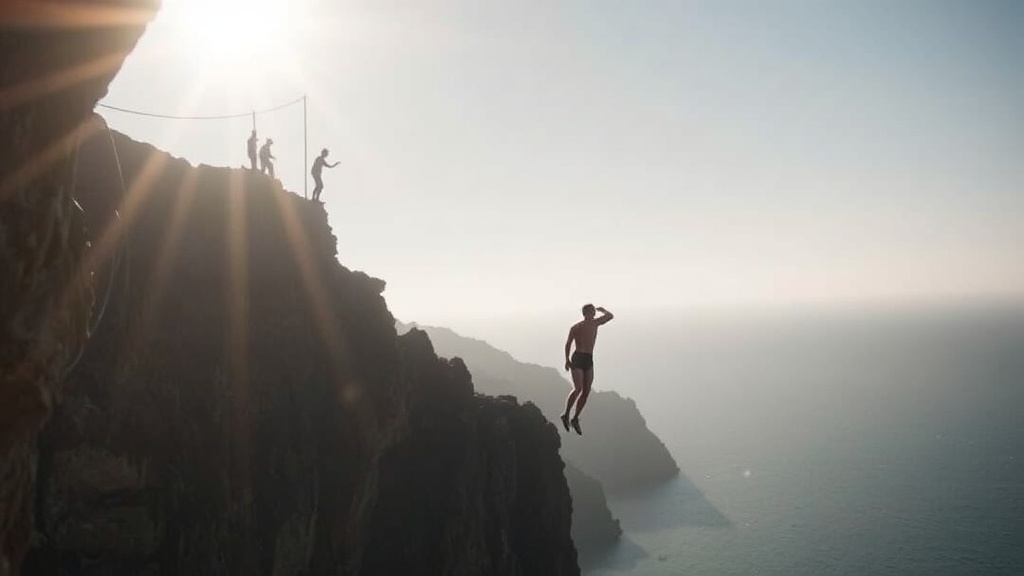
Impact Precision: Bracing for Cleaner Cliff Diving Entries

Ever wonder how experienced cliff divers hit the water with such minimal splash? It isn't just about grace; a clean, controlled entry significantly reduces the immense impact force on your body and lessens the risk of injury. This quick tip focuses on the fundamental, yet frequently underestimated, aspect of body tension – specifically, how to brace your body for a safer, smoother plunge into the water. Mastering this technique means you’re not just making a visual statement, you're prioritizing your well-being with every descent.
What role does core strength play in water entry?
Your core is the bedrock of a stable water entry. Think of your body as a rigid column – any weakness or uncontrolled movement in the trunk will cause your form to buckle upon impact, leading to an uncomfortable (and sometimes painful) smack. Engaging your abdominal muscles and squeezing your glutes creates a protective shield, helping to prevent your back from arching or hollowing out when your hands first meet the surface. A strong core allows you to maintain that crucial straight line from fingertips to toes, ensuring the water's force is distributed along your body, rather than hitting a vulnerable, unbraced section. This engagement truly makes a difference, turning a potential jarring collision into a more controlled deceleration.
How do I achieve the 'pencil' or 'pin' body position?
The classic 'pencil' or 'pin' entry position is your best defense against high-impact forces. It starts with your upper body: extend your arms overhead, keeping them tight against your ears, and interlock your hands (or place one hand over the other) to form a wedge. Shrug your shoulders up toward your ears – this 'locks' your head securely between your arms, preventing whiplash or your arms from splaying out. For the lower body, keep your legs pressed together with absolutely no gap; even a small opening will catch water and create resistance. Point your toes like a ballet dancer; this elongates your body and helps you pierce the water's surface efficiently. Every muscle, from your neck to your ankles, should be actively engaged – no loose limbs!
What's the right way to think about impact absorption?
Rather than 'absorbing' impact in a soft, yielding way, your goal is to 'cut' through the water with minimal resistance, creating what divers call a 'rip entry.' This occurs when your body is so rigid and perfectly aligned that it pulls a pocket of air down into the water, resulting in a distinct, satisfying 'rip' sound and almost no splash. If your body tension falters, even slightly, the water will find the path of least resistance – often resulting in a painful 'pike' or 'arch' if your core is soft, or your arms being forced back if your shoulders aren't locked.