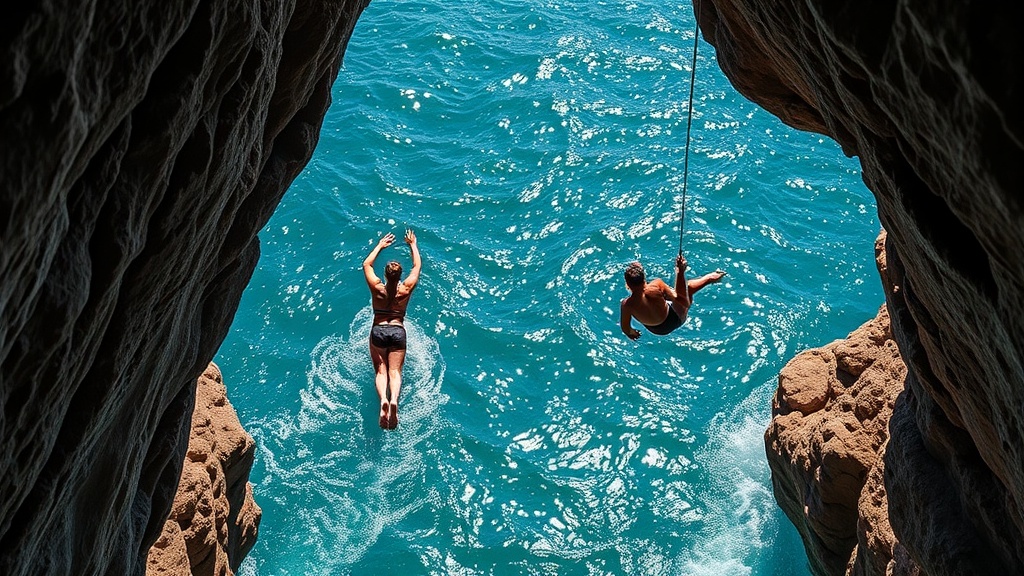
5 key Cliff Diving Training Techniques Every Athlete Must Master

Mastering the Vertical Entry: Reducing Impact Force
Progressive Height Training: Building Confidence Safely
Spotting and Visualization Techniques for Precision Landing
Core Strength and Body Tension for Clean Form
Mental Conditioning: Overcoming Fear at Extreme Heights
Cliff diving demands a rare combination of raw athleticism, mental discipline, and technical precision. This post breaks down five training techniques that separate casual jumpers from competitive athletes—covering everything from entry mechanics to breath control. Master these fundamentals and the difference shows immediately in cleaner entries, longer breath holds, and the confidence to handle bigger heights.
How Do Professional Cliff Divers Train for Impact Forces?
Professional cliff divers train for impact forces through progressive height exposure, plyometric conditioning, and specialized water entry drills that distribute force across the entire body. The water hits back hard—especially from 20+ meters—so the body must learn to absorb and disperse that energy without injury.
The physics aren't forgiving. From an 85-foot platform (roughly 26 meters), divers hit the water at nearly 53 miles per hour. That impact generates forces equivalent to crashing a bicycle into a wall. Without proper technique, injuries range from bruised heels to compressed vertebrae.
Plyometric training forms the foundation. Box jumps, depth jumps, and single-leg bounds develop the explosive power and tendon resilience needed for takeoffs. Here's the thing—it's not just about leg strength. The entire kinetic chain must fire in sequence: ankles, knees, hips, core, shoulders. Miss one link and the entry suffers.
Water entry practice starts low and builds gradually. Most competitive divers begin entries from 5-meter platforms, perfecting the "rip" technique before advancing. The goal? Enter the water with minimal splash—a sign that the body sliced through the surface rather than slapping against it. Divers train with USA Diving-certified coaches who emphasize progressive overload, never jumping from heights that outpace technical readiness.
Many athletes supplement pool work with dry-land training using foam pits and spotting rigs. These allow repetition without the physical toll of repeated water impacts. The catch? Nothing fully replicates the real thing. At some point, you've got to commit to the height.
What Breathing Techniques Do Cliff Divers Use to Stay Calm?
Cliff divers use diaphragmatic breathing, box breathing, and CO2 tolerance training to stay calm and extend breath holds during descents and underwater recovery. The mental game matters as much as physical preparation—racing hearts and shallow breathing destroy focus at the worst possible moment.
Diaphragmatic breathing (belly breathing) activates the parasympathetic nervous system, slowing heart rate and reducing anxiety. Before every jump, you'll see competitive divers taking slow, deep breaths that expand the abdomen rather than the chest. This isn't relaxation theater—it's physiological preparation for the stress ahead.
Box breathing (4-4-4-4 pattern) comes from Navy SEAL training protocols and works equally well for divers: inhale for four counts, hold for four, exhale for four, hold empty for four. The rhythmic pattern anchors attention and prevents the mind from spiraling into what-if scenarios. Red Bull Cliff Diving athlete Gary Hunt has spoken publicly about using structured breathing to manage pre-competition nerves.
CO2 tolerance training builds capacity for underwater discomfort. Divers practice static breath holds in safe environments—pools with supervision—to extend their comfort zones. Table workouts (alternating breath holds with short recovery periods) train the body to function with improved carbon dioxide levels. Worth noting: this training carries real risks and should never be attempted alone. Blackouts happen silently.
Some divers incorporate the Wim Hof Method—though the scientific jury remains mixed on some claims, the breathing exercises themselves improve CO2 tolerance and cold exposure resilience. The cold part matters too; many competition sites feature water temperatures below 65°F (18°C), and the shock of entry can trigger involuntary gasping.
Breath Control Training Comparison
| Technique | Primary Benefit | Training Frequency | Difficulty Level |
|---|---|---|---|
| Diaphragmatic Breathing | Calm nervous system | Daily, 10-15 min | Beginner |
| Box Breathing | Focus and composure | Pre-jump ritual | Beginner |
| Static Apnea Holds | Maximum breath duration | 2-3x weekly | Intermediate |
| CO2 Tables | Hypoxic tolerance | 2x weekly | Advanced |
| Oxygen Tables | Low O2 adaptation | 1-2x weekly | Advanced |
Which Strength Exercises Matter Most for Takeoff Power?
The strength exercises that matter most for takeoff power include Bulgarian split squats, single-leg Romanian deadlifts, medicine ball throws, and core stability work that connects lower body drive to upper body positioning. Raw strength means nothing without the explosive speed to deploy it in a fraction of a second.
Takeoff windows are brutally short. From the moment a diver initiates movement to foot release, maybe 0.3-0.5 seconds elapse. There's no time to grind through a slow contraction—the body must fire maximally and immediately. This demands rate of force development (RFD), not just maximum strength.
Bulgarian split squats build unilateral leg strength and stability. The rear foot improved position mimics the forward lean many divers use at takeoff. Single-leg RDLs (Romanian deadlifts) strengthen the posterior chain—hamstrings, glutes, lower back—while challenging balance. The diver's takeoff leg absorbs tremendous force; these movements prepare it.
Medicine ball work bridges the gap between strength and power. Overhead throws, rotational throws, and chest passes develop the triple extension (ankle, knee, hip) that drives elite takeoffs. The SPRI Xerball and Power Systems medicine balls are common sights on pool decks—durable, grippy, and available in weights up to 20+ pounds for advanced athletes.
Core training often gets misunderstood. Crunches won't help much. What matters is anti-rotation and anti-extension stability—the ability to maintain a rigid torso while forces try to twist or bend it. Pallof presses, dead bugs, and Copenhagen planks build the trunk stiffness that keeps divers simplified during flight. A loose core equals a sloppy entry.
How Do Divers Develop Spatial Awareness for Complex Moves?
Divers develop spatial awareness through trampoline training, dry-land spinning rigs, visualization protocols, and graduated progression from simple to complex maneuvers. Knowing where the body is in space—while flipping, twisting, and plummeting toward water—is a learned skill, not an innate gift.
Trampolines serve as the laboratory for aerial awareness. Divers can rehearse somersaults and twists with lower consequences than water attempts, getting dozens of reps in minutes. Many elite programs use Red Bull Cliff Diving-style training facilities with Olympic-grade trampolines and overhead spotting rigs.
Dry-land spinning rigs (use systems that suspend divers from above) allow rotation practice without the landing impact. Coaches can manually assist or slow rotation, helping athletes feel the correct body positions. These rigs aren't cheap—quality setups run thousands—but they're standard equipment at national training centers.
Visualization deserves more respect than it receives. Studies on motor learning consistently show that mental rehearsal activates similar neural pathways as physical practice. Competitive divers spend hours visualizing their lists—walking through each takeoff, feeling the rotation, spotting the water, executing the entry. Some use video analysis, studying footage of themselves and competitors to internalize timing and position.
The progression matters. Nobody learns a triple-twisting double backflip on day one. Divers build complexity gradually:
- Forward dives and straight jumps establish basic confidence
- Forward and backward somersaults add rotation
- Twisting entries introduce lateral rotation
- Combinations merge somersaults with twists
- Armstand takeoffs (for platform specialists) add inversion complexity
That said, even simple dives demand precise awareness. A poorly executed forward dive from 20 meters still carries injury risk. The fundamentals never become optional—they just become automatic.
What Mental Training Do Elite Cliff Divers Practice?
Elite cliff divers practice visualization, pre-performance routines, fear management techniques, and mindfulness training to maintain focus under extreme pressure. The mental skills separate those who compete from those who crumble when standing on a platform the height of an eight-story building.
Fear isn't the enemy—it's the alarm system. Healthy fear keeps divers from attempting dives beyond their readiness. But uncontrolled fear paralyzes. Athletes learn to recognize fear symptoms (racing heart, sweaty palms, negative self-talk) and reframe them as preparation signals rather than danger warnings. The body is ready, not broken.
Pre-performance routines create familiarity in chaotic environments. Whether at a local quarry or the Possum Kingdom Lake Hell's Gate competition site, the routine stays constant. A specific breathing pattern. A set number of bounces. A consistent cue phrase. These anchors prevent the mind from wandering into catastrophe scenarios.
Mindfulness training—paying attention to the present moment without judgment—helps divers stay process-focused rather than outcome-obsessed. Worrying about the score, the crowd, or the previous miss destroys presence. Apps like Headspace and Calm have made this training accessible, though many divers work with sports psychologists for personalized protocols.
Goal-setting follows specific frameworks. Outcome goals (winning the competition) matter less than performance goals (executing three specific technical elements) and process goals (maintaining the pre-dive routine). Control what you can control. The judges' scores aren't on that list.
The best divers embrace failure as data. A botched entry isn't a character flaw—it's feedback. What changed? Was the timing off? Did the spot drift? Each mistake becomes a lesson rather than a burden. This growth mindset (yes, the term is overused, but the concept holds) keeps athletes improving through years of training.
Cliff diving rewards the complete athlete—body and mind trained in tandem. Start with the fundamentals, respect the progression, and build systematically. The height will wait for those who prepare properly.